The World
Winds of Ruin
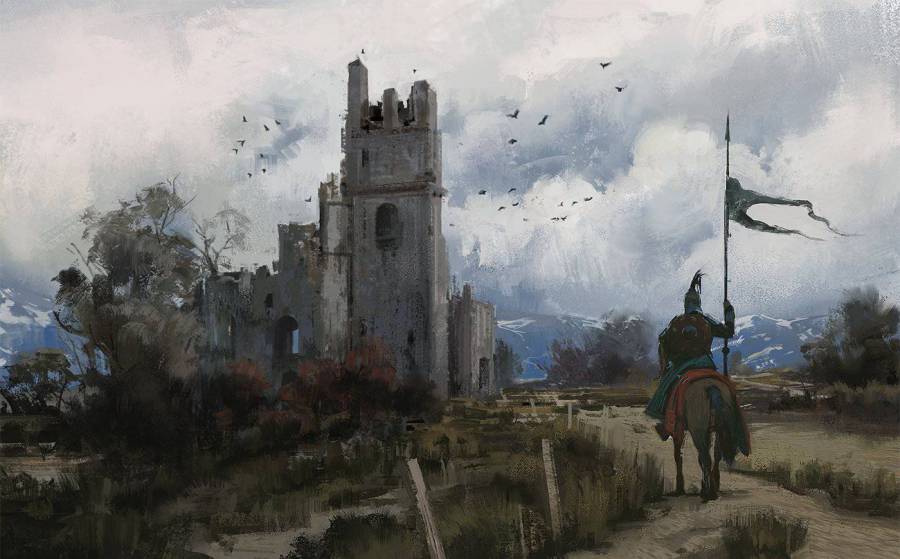
The world is tired. Grass breaks through between the stones of civilization. Walls crumble, and lands long inhabited are home now to dust and wind and ghosts.
From the navel of the world, a great empire has ruled for six hundred years. The first emperors conquered east and west, built cities, claimed the world. Now the Golden Age has ended, and the empire rots in an Age of Madness.
At first this collapse was violent, but even the entropic force of civil war has steadily yielded to the exhaustion of the age. Each winter is colder and longer than the last, and ice creeps from the edges.
Yet despair is not total. Scholars speak of a cycle: the receding of the ice, the return of the wise kings. And at the edges, where life is most difficult, there may still be stories yet untold.
Our story takes place at one such edge, a backwater called Freemarch.
Places
Freemarch
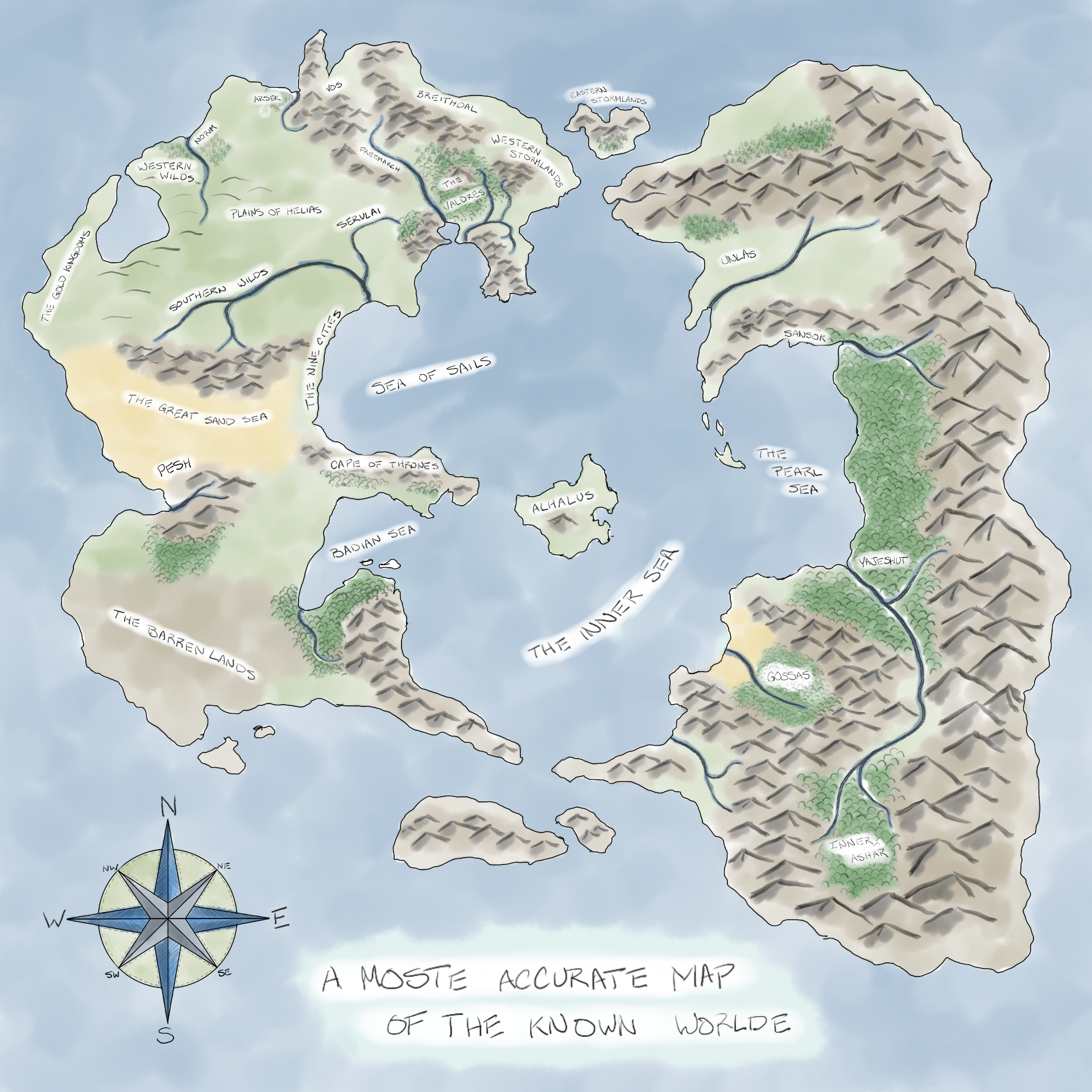
Freemarch is a frontier, the last outpost of civilization and the church, the place where roads end. Beyond lies the frozen north of Vos and Breithdal, and to the east, the all-devouring forest of the Valdres.
It is also a crossroads where deep-delving Dwarves, Vosiri trappers, and treasure hunters mingle, all seeking southern gold for their wares. Year after year, there is less to go around.
It is a dangerous country; a hiding place for outlaws and rebels. In the hills, there live a people older than the old kingdom, who honor their gods with the blood of civilized people. Beasts and monsters dwell here, in places unconquered or abandoned by men. Marchmen may gather on churchdays, but they also remember the words and offerings of old, the rites which keep the night-things at bay.

History
The Old Kingdom of Aebor
Ages ago, before the rise of the Pearl Emperors, the Seris valley was not a mere march, but the heart of a great kingdom.
The land was called Aebor, from the old-speech for the constellation now called the Northcrown. The deeds of the kings of Aebor are the stuff of legends. It is said that they led their people out of the east, after the great flood; that they were friends of the Tormen, and enemies of the Southmen and the Vosiri. The kings of this time built no cities, but ruled from a castle built on Mount Arda, at the heart of their kingdom. The old kings were buried at the great temple of Poliad, for the holy mountain was not yet swallowed by the forest.
The Epic of Seimar's sons tells the story of the kingdom during the Second Age of Sorrow, when the world froze. King Seimar, as he lay dying, divided his kingdom and followers between his sons, Toriach and Morach. Toriach, the elder son, brave and stubborn, delved with his followers into the caves below the Dragonmounts, in search of the inner fire. Morach the Clever founded a stronghold atop the hotsprings beside diamond lake, and called the place Morad. Winter besieged the settlement, and terrible monsters rose up to threaten the weakened king: giants, thunderers, and dire-wolves. The winter lasted a generation, and it was Morach's children who stepped forth to reclaim the kingdom. Toriach and his followers were never seen again, though the children of Morach delved deep in search of their lost kin. The spring of the great thaw is marked as year 0 in the northern reckoning (23 years before the start of the imperial count of years).
The Dwarves first appeared in the years after the thaw, and the king swore friendship with them.
The last of the line of the old kings was Falrerk the Unlucky, thought to have been murdered by his usurper, the first of the Sorcerer Kings. They wielded dark powers stolen from the School of Arnis, and led Aebor against Tormar and Serulai in the War of the Torch. They abandoned the old gods, breaking menhirs and desecrating temples to appease new patrons. The last of them, Guirn the Cruel, was slain in battle against the Serulaians in 531; he was the last king of Aebor.
Their black dynasty lasted four generations; all but Guirn are entombed within Mount Olek, which is still sometimes called the Black Mountain.
Conquerors from the South
The kingdom was exhausted by the wars of the Sorcerer Kings. The Valdres-wood crept over the boundary stones in the east, swallowing first the holy mountain and then the eastern district. The hillmen, long suppressed, returned to ravage the outer settlements and exact a bloody vengeance. Most towns found what protection they could as vassals or clients to the lords of Serulai. Gloamingwatch, the castle of the first kings, was left a crumbling ruin.
With the southern rulers came southern priests, emissaries of the Church of the Authority. The lordly patrons built the first churches, tore down shrines and temples, and even built a monastery at the edge of Diamond Lake.
In 663, Serulaian patronage gave way to imperial rule. Work was begun on a new fortress at the south of the march, to secure the imperial frontier. The church was now backed with the strength of imperial law, though the region was largely spared the horrors of the great inquisition.
For a brief time, the March prospered; Imperial rule brought trade and investment along with its taxes and tithes.
This prosperity was not to last. Costly wars in the east drew gold away from the northern frontier. Thirty years of bloody civil war made things worse. The War of the Three Emperors was fought far from the March; mass conscription, famine, and finally rebellion brought the chaos home. By 759, the last of the imperial garrison had been siphoned off to fuel the conflagration, and the Lords of Morad fought with Serulai for control of northern trade. In 811, the last of the border forts fell to the northern army. After a long and bloody war, the March was free of the Empire and their Serulaian vassals.
The Dawning Age
It was not to be a happy peace.
The returning army brought back plague. For fifteen years, disease wracked the country. Trade ceased entirely. Crops rotted in the field as rich and poor alike died shivering in their beds. Some outlying villages died out entirely; others were simply abandoned by the survivors. Even today, eight years after the last deaths, many bear the pox-scars.
Many also noted a steady shift in the weather, a chilling which had contributed to the famines of the eighth century, and which was now almost certainly growing more severe.
Serulai, stricken earlier by the plague, and with a better climate, was faster to recover. In 825, the old bonds of patronage were revived. A powerful Serulaian lord rules the March as far north as Nestic; he has learned something from the Imperial bureaucrats so recently driven out of Serulai, and taxes as heavily as he can manage. North of Nestic, the March is "Free," but lawless might be a better term. The petty lords of the Seris bicker with each other, and look south with hatred.
And each passing winter is a little colder, a little longer than the last.
Important Places (WIP)
Morad, the Old Capitol
The city was founded by Morach the Clever on four low hills overlooking diamond lake. It was built in the days of the Good Kings and their champions; it suffered in the iron grip of the Black Dynasty; it was sacked by St. Garlaian the Redeemer.
The tallest of these hills bore a hotspring, which already held a shrine to Gasa. Today this hill is the Hightown; the old spring is a now a subterranean temple. The wall-houses, the oldest dwellings in Morad, rise 4 stories from street level to the top of the hill. Only Steep Street runs up to the King's square, winding up the hillside through two ancient gates. The Old Keep, the seat of Morach's heirs and now the council of stewards, overlooks the whole city. The Sorcerer Kings abandoned the keep as the royal seat (they ruled from the fortress Gloamingwatch), but they did greatly expand the dungeons beneath the keep, creating a prison called The Pit.
Sarlai Square (named for southern traders) holds the city's major market, and great merchant houses surround it in the district called Redgate (for the bloody battle when the conquering Saint Garlaian breached the city). The finest of the noble houses within the city surround the true civic center, the Old Square, which is not far from the Hightown gates, in a district called the Blue Quarter. Three other, smaller squares can be found within the walls, including St. Rislan's Square, known more often as the Witchmarket. Hedge mages, witches and druids gather here once a month, offering their services and peddling numberless trinkets, talismans and amulets.
Nestic, the Boomtown
The Valdres
The Valdres is a forest, but this word is insufficient. It is a kingdom unto itself: it has its own customs and laws, its own gods, and it defends its borders.
It stretches east as far as the Dawn Mountains, a sea of beeches, maples, and the ancient oaks. The mightiest of these are the ghostwoods, which, it is said, never shed their leaves, except in the long night of an Age of Sorrow. Dark things move beneath the canopy, and the leaves whisper endlessly. Beneath the tangled roots, the moss and fallen leaves, there are ruins in the Valdres; villages, tombs, and shrines abandoned to the forest, and the things which live there.
In the north, past the Holy Mountain, the forest turns to pine. Unlike the south, this region has never seen human settlement. It remains perfectly desolate and untracked; the rare travelers through this area prefer the bleakness of the Rustlands to the northern forest.
To the merchants of the Empire and the explorers of the western kingdoms, the Valdres is as impassable as the towering Dragonmounts--the edge of the world.
As the old stones and swallowed villages tell, it was not always thus.
History
Ancient Tormar
The Tormen have lived and worshiped at the edge of the Valdres for millenia; their legends stretch back into the darkness of prehistory. Certainly they predate the coming of the Marchmen in the Age of Glory, and before this time, only their own legends exist as a record.
The oldest sagas tell that they were first men to walk the earth, freed from ice by the sun god Shaulk. They tell of the deeds and the tragedies of kings and champions, the wars of the ancient clans, and of the people's struggles with the western giants and the wood-elves, and other, stranger creatures of the Valdres.
They trod paths through the Valdres, sunken, mossy roads which flood in fall and freeze in winter. They hunted elk, ironboar and the lumbering visent with spears of ghostwood. Theirs was the Kingdom of Tormar, though the kingdom was more often contested or divided between the chiefs than it was united under a strong king.
Each petty chief held his own little stronghold, but the kings kept no permanent fortress or capitol. The only constant was the Necropolis of Hansalk, the burial site of the ancient kings and the great legendary heroes. Here, amidst the great stones and the ghostwoods, the court assembled each spring to seek the counsel of the ancestors, the forest spirits, and the gods.
They taught the Marchmen the words and rites to appease the High Gods, but theirs was also a pantheon of innumerable minor local deities, nature spirits, and legendary ancestors. They filled the forest with shrines to the spirits, and tombs for the honored dead, and they raised stones to ward off those things that would not be appeased. In that age before the coming of the Marchmen, they built the Poliad, a great carven temple, on the slopes of the Holy Mountain, which rose above the western edge of the forest.
The Fall
The War of the Torch brought about the end of Tormar. The Black Kings brought fire and dark magic, fighting the forest and the Tormen at once. The forest won, and men of both kingdoms lost, but the Tormen most of all. The wood crept over boundary stones broken by the invaders, choking towns and villages already injured by the war. Cleared land, farmed for centuries, was consumed in days. Whatever pacts the ancient Tormen had struck were gone now, and both sides were driven from the wood. Those that could not flee, or who could not flee fast enough, were never seen again.
The Poliad was swallowed, the sacred mountain made an island as the green tide rolled west. The Ballad of Orin tells the story of the last king of Tormar, consumed along with the Necropolis, entombed alongside his ancestors.
Tormen still live in a few towns and villages to the south of the wood, settlements huddled around their ancient hillforts. No roads connect their plain with the west, though southern ships sometimes find their way to the mouth of the Greenwater. Though they may meet Tormen here, they do not find Tormar; it is three centuries dead, and buried within the Valdres.
The Dragonmounts
This mighty, branching range of snowcapped mountains divides the temperate regions of Freemarch and the Valdres from the frigid outer north. Two major passes cross the great range: the Highgate, between Freemarch and Vos, and the Howling Pass, between Vos and Arsek. The Dragonmounts are a volcanic range; the upper layers are riddled with old lava tubes and other passages, often rich with ore. Deep beneath the mountains, there are yawning black chasms and sprawling halls of living stone.
Two Irondwarf holds, Arzinvur and Gurandolim, lie within the mountains. The shattered ruins of a third hold, Menkaashvur, still overlook the Highgate. Mountain orcs, grey skinned and somewhat stooped, also dwell within the deep caves, but they are far from the worst inhabitants. Dragons, undead, and other terrible monsters lurk in the depths, eager to devour would-be explorers.
Vos
The Land of Long Nights. Vos is a cold and barren country; the land below the creeping glaciers is home to little more than lichen, and there are no great herds to match those of the Stormlands.
The Vosiri are clearly distinct from their southern neighbors; taller, with dark skin and slanting eyes. Vosiri legend holds that they originated in the Seris valley, but were displaced by migrations from the east. The Vosiri speak their own language and worship a sky goddess along with numberless lesser spirits. They do not believe in any afterlife or soul, but use ancient family chants to remember their dead.
Most Vosiri make their home on the coast, fishing the long bay and growing a little during the short summer. Wealthier clans commonly keep a breed of woolly cattle as well. On the slopes of the dragonmounts to the west of the Highgate, there is an icy wood, the Forest of Silence; a few hunters stalk these woods for furs to sell in the south. Others, brave or foolish, search the mountains for the rich tombs of the Cold Ones, an ancient and evil race of sorcerers.
Breithdal
Frozen Breithdal, where the ice never melts.
Even more so than Vos, this is a barren land. No humans live here, and few animals. Some courageous explorers have reported structures half buried in ice, but most do not return. If there are ruins within the ice of Breithdal, they must date back to the Drowned Age or earlier; the country has been uninhabited for millenia.
The Stormlands
Beyond even the forest of the Valdres are the Stormlands, the edge of the world. The great plains stretch into the frozen north, home to great herds of elk and the beasts which feed on them.
No men live here; it is said by the Tormen that the gods of the land (said to take the form of great storm-riding eagles) strike down any who dare settle.
The Mistlands
North and west of Serulai, the Plain of Helias ends in the ancient Stonehills. The is the frontier of the Mistlands, the twin kingdoms of Arsek and Norim. It is a land of rain and fog; mossy hills break through the dense forest like islands in a sea of trees.
Great herds of sheep graze the hillsides around the clanholds, each stronghold the domain of a high-blooded lord and his retinue of knights. The lords recognize no authority but the druid-kings, high priests who speak for the gods, oversee lordly disputes, and rule the land in times of great trouble. They are revered as the mortal children of Shaulk, and claim a line of descent which stretches into the distant past.
The knights of the Mistlands ride sturdy ponies, surefooted on the hills of their homeland. They skirmish from horseback, throwing javelins before dismounting to fight on foot; they wear armor of heavy cloth and metal scales.
Races and Peoples
The Dwarves (WIP)
see https://windsofruin.grygon.com/books/winds-of-ruin/page/dwarves
The Elves
The Races of Men
Orcs
In the north, orcs first poured from their mountains during the Second Age of Sorrow, savage bands which struck without warning or mercy, burning, killing, and stealing as men huddled in their halls and keeps. With the turning of the age, they were driven out of the march and into the hills and forests, where they dwell to this day.
Today, two major races exist, the Grey and the Green. The grey orcs are the smaller and weaker of the two, living in great numbers beneath the Dragonmounts and warring endlessly with the dwarves. They are rarely seen outside their caves, but are said to be stooped and stony-skinned. They love fresh meat and greatly value steel weapons.
The green orcs long ago abandoned the caves; today they wander the Valdres-wood and the Rift. They are more often seen by marchmen than their cave-dwelling cousins. They are tall and muscular; their skin brown or light grey (though the adults are accustomed to stain themselves with moss). They are fearsome warriors, and their disparate bands are almost perpetually engaged in armed struggle against each other. Their raids are much feared in isolated settlements and farmsteads, but more often they come openly to trade. Half orcs are sometimes produced by this mingling. Even where orcs are rarely seen, especially large, healthy children are often said to be "quarter-orcs."
In the north, both breeds of orc believe that the mountain god Ossat is their creator, but they worship no gods. Both races practice ritual cannibalism as a funeral rite.
It is said also that orcs dwell in the Barrier Mountains, in buried cities; the Imperials call them Stone-Men, and they buy peace with a yearly tribute of slaves.
Magic
A needle of iron, marked with the sign of the Bear-Star, will point north when floated on water. A spindle of blue agate will always point rimward.
According to Haron the Founder, a certain spiral sigil, carefully etched onto the surface of a quartz gem, will store and collect light; an ancient phrase and a gesture of the hand will cause the gem to glow like a torch.
According to Peltor of Karsis, a few words of the high speech, spoken with force of will and an understanding of the underlying formula (expressed in On the Workings of the Heavens as a complex tangle of lines and symbols) can produce a bolt of lightning from a clear sky. He also cautions that the spell is especially taxing, and that the feeble and the unready are more likely to destroy themselves than produce any real result.
According to Olcernus the Great, the blood of a living dragon, mixed with ash from the body of a dead king, quicksilver, and aqua regia, forms a vapor which obeys commands given in the high-speech, and which rapidly reduces anything it touches to ash.
Warmages serve kings and emperors in battle. Windsingers send ships safely on their way. Hedge wizards mumble over old boundary stones, and keep the night-things at bay. In every corner of the world, magic leaves its mark.
The Lineage of Alhalus
Men have wielded magic of various sorts for the whole of recorded history. The Book of Aliax says that the authority taught man magic before the fall and the breaking of the world. The mages of the Age of Heroes and the First Age of Man are the stuff of legends--they are remembered as heroes, demigods, and monsters.
Most histories would begin instead at the dawn of the Age of Glory, with the rise of Alhalus, the navel of the world. From its rocky island, the city-state became the great power of the age, and in its great forum were found wonders from every corner of the earth. Here, the Garpriests of the great temples honored their gods and wielded powerful magics in their name.
But the priests were not alone in their pursuit of knowledge and power.
The wise men of the city found the marketplace as rich in knowledge as it was in foreign treasures. The first of the cynic-mages (from the old Heliac for "doglike") learned their tricks from poor foreigners and shoddy copies of ancient books, but where each Garpriest had a single teacher, each cynic-mage had twenty. Many of their names are lost to history, but their spells are not. Jerastos of Gor named the principle elements (along with many others less well remembered), and divided magic into two types, two ways to manipulate the elements: magic which creates and magic which alters. Aelika the Mute created a lexicon of the High Speech, which she theorized was the Divine Language.
The power of the Garpriests waned, their mysteries drained away, and the influence of the mages grew to threaten the oligarchs themselves. In the end, only exile saved the cynic-mages from slaughter.
Haron the Founder, himself a noble, built a school not far outside the city. He called it the Orchard of the Perfect Thought, though we know it as the Academy. He and his followers divided the school and the spells taught there; they named the schools of magic still used today. The school grew quickly, and its library was called the richest treasury in the world.
Amid this flourishing, Peltor of Karsis formed the first comprehensive theory of magic. He and his followers created hundreds of spells; perhaps most notable are those capable of unraveling the threads of magic. Peltor is still sometimes called the Spellbreaker. But within a generation, even the Peltorists would be overshadowed by Olcernus the Great, whose refinements and explanations of Peltor's work would make his writings the basis of all subsequent inquiry and practice.
As the age neared its end, the power of the Academy waned. It was sacked by the Hierarchs of Alhalus in the chaos that preceded the Second Age of Sorrow. Numberless works were lost in the sack; great sages preserved only by a passing mention in a surviving text. These remnants are the basis of all modern science.
Since the destruction of the Academy, further development of the art has been scattered and secretive. Aelika's ideas were more popular with the prophets of Badia than they ever were in Alhalus. They still shine through in the holy texts of the church, especially the Book of Aliax; today she is revered as St. Aelika the Mute and honored with a feast at the autumn equinox. The works of Olcernus and his followers have blended with church doctrine, truly becoming the foundational texts of most magical study.
In 554, the Academy was refounded as an imperial library, commonly called the Second Library. Though its patrons have made it an impressive repository of knowledge, it will never again be the center of learning it once was.
Theories and Traditions
Only a rare few mages advance the art at all, and these few do so because they stand upon the work of those before them. Modern sages divide magical traditions along a few great lines, and an infinity of little fissures and schisms.
First are the little-mages, those who practice magic without any real training or scholarly knowledge. They are everywhere, but generally below the attention of those who keep the secrets of ancient arcane lineages. They make do with folk wisdom passed down from generation to generation, simple magic mixed with superstition and practical experience. Rare is the Hedge Mage who is not also a bard, an apothecary, and a fortune-teller.
Next are the diverse lineages outside the greater Alhalic tradition, the ancient cults of Gossas and Sansok, the Whiteeyes of Pesh, and the Seers of Unlas. This are further divided by their age--the antediluvian and the post. That these traditions might still bear secrets from before the Drowned Age is a subject of endless doubt and speculation.
Naturally, western scholars are far better equipped to categorize themselves. Even in the west, and even after the conquest, there are innumerable renegade lineages, the products of exiles and eccentrics; these are the illegitimate lineages. Of those who accepted the Alhalic tradition, the first to set themselves apart were the Aelikans, so unorthodox in their philosophies as to be considered almost illegitimate. Several modern traditions still call themselves cynics, rejecting the exile of the mages from politics and religion, even as they generally accept without examination the teachings of the exiles. Then there are the Peltorists, less known for their particular doctrines than for the rejection of the "refinements" of Olcernus. They claim the theories of Peltor are more than sufficient in the hands of diligent students. The Peltorist traditions are generally backwards-looking; unsurprising, given that so many of Peltor's works are lost, or else survive only in critiques by Olcernus.
As for Olcernus, few traditions today would call themselves Olcernists; that term is usually reserved for the historical followers and students of the great mage. Such is the extent of his influence that to be a modern Olcernist is almost without meaning.
The Church
Across the world, temples are raised to numberless spirits and gods.
Some are totally false, invented by mad or evil men. Others are not gods, but daemons, whispering voices from beyond the sacred boundary of the world. They promise power, hope, and truth, and deliver damnation.
He said that He found all the souls of men wretched, drowning in a Sea of Torment, but that he saw divinity within them, and took pity. He said that the Authority created the world with a thought, a paradise, an oasis, and island in the sea. He said that he walled the world with Word and holy Water, and gave the souls form, and created Man. Man who is imperfect, and tainted, but who can be purified, who can arise to join Him.
His Word spread. The Prophet of Chains worked miracles, and by his death, toppled a tyrant. But it was not enough. In east and west, Hestria and Leng, men were seduced by the promises of daemons. They tore the world apart with their warring, and thought themselves gods. The flood wiped them from the world and divided the land into east and west, separate and apart.
And still His Word spread. More prophets came to serve Him, and more Tyrants to serve His enemies, the daemons. Finally, 834 years ago, the Last Prophet arose, the Prophet of Blades, the first Radiant Emperor. The daemon-serving kings fell, and the Seven Saintly Armies of the first Emperor swept across the world. In Holy Anhalus he found his throne, the throne from which his sacred line would rule the world.
The Old Gods
The Old Gods of the north are numberless and everywhere. Spirits dwell in every grove, hill and stream; they haunt the menhirs and boundary stones. Every village has its own gods, and it is the duty of the druids to know them, to divine their wills, and avert their wrath.
Above all others are the High Gods, the lords of the spirit world. Only the High Gods transcend locality, and they are honored foremost at every great temple.
Shaulk, the Judge of the Heavens
Shaulk is the creator, and the distant ruler of the world. He treads the heavens each day, and his eye is the sun. In myths, Shaulk is the arbiter of the other gods, but never interferes in mortal affairs. The giants and ancient cyclopes are thought to be his children.
Shaulk is honored in a festival at the winter solstice, when worshippers lament his cruel inattention, and call on him to return his gaze to the earth. He is rarely depicted in statues; more often his presence is invited into a temple with the inclusion of sunlight.
The yearly cycle of the sun-god's attention is mirrored in the cycle of time. At the end of time, Shaulk shall perish, and all light and heat vanish from the earth. The earth and the gods themselves shall die in the endless night. But time is circular, and he shall be reborn from darkness to remake the earth.
Gasa, the Earth-mother
Gasa is the dweller in the earth, the mother of gods and mortals. From her all life springs, and to her it returns. She weaves the souls of mortals in her home within the earth, and when men die, she unweaves them. The souls of mortals not properly buried sometimes do not find their way to her, but walk the earth as abominations.
Parents pray to Gasa for healthy children, and the dead are buried and appeased that they might swiftly find their way back to her loom. Miners, jewelers, and metalworkers make offerings to Gasa in exchange for their theft; displeased, she can shake the earth or stoke mountains with fire.
Gasa's presence is never invoked with images; offerings to the Weaver must be made in caves, or buried beneath rich soil.
Diada, the Silver Maiden
Diada is the goddess of water and the moon, the nourisher and protector. She protects mortals against monsters and evil spirits, watching over the earth when Shaulk's eye is elsewhere. In tales, she grants insight to heroes through cryptic visions. Those gifted with wisdom are said to have been touched by Diada.
Her statues are always carved from white stone, and she is depicted as a maiden with long hair and a sword. She is honored with festivals in the spring and fall, and her symbol, the crescent moon with points facing upward, is said to be a talisman against evil. Warriors often offer the arms of their enemies to Diada, casting them into rivers and lakes.
Tiroc, the Pale Man
Tiroc is the god of death and winter. He chills the bones of old men, covers the land with snow and ice, and ends the lives of mortals when their time is up.
Tiroc's gaunt statues are carved without faces, for it is said his face is known only to the dead. People pray to Tiroc for mild winters, but it is said that no prayer or offering can ever shift one's appointed time.
The debt or price due to Tiroc is a common idiom, with a dual meaning. "He paid Tiroc's price" could mean that he died, or that he suffered the ravages of winter (to his person or his property).
Somun, the Whisperer
Somun is the goddess of sleep, dreams, and prophecy. She brings on sleep, and haunts the minds of sleeping mortals. Seers are said to be blessed by Somun, and madmen cursed by her. Tales say that Shaulk first granted his eye to Ylgal, and gave it to Somun when Ylgal angered him.
Mortals pray to Somun for true visions of the future, and relief from madness and delirium. Her statues depict a hunched old woman with a third eye upon her brow. Birds are all servants of Somun, and sometimes bear messages for her. Owls are her harbingers.
Ylgal, the Wanderer
Twin brother of Somun, the god of exiles, wanderers and criminals. Of all the gods, he is the greatest lover of humankind. According to myth, Ylgal was blessed with the gift of prophecy by Shaulk, and instructed to keep the first men simple and obedient. But Ylgal defied Shaulk, and took pity on mankind. He gave man knowledge of fire and metal, and the first secrets of magic, and mankind grew stronger and no longer lived in fear and darkness. When Shaulk discovered his treachery, he took back his eye and cast Ylgal from the ranks of the gods, to wander the earth for all time.
Ylgal's statues depict a weak and weary traveller, blind and scarred. They are never raised within a temple or shrine, or even under a roof; holy groves shade his statues from the light of Shaulk. Ylgal is honored before journeys and on safe returns.
It is said that Ylgal favors those who are kind to guests.
A Moste Accurate Mappe